Competitive Benchmarking
Competitive position shifts constantly. Catch gaps in price, share, and positioning while they’re still small, before a competitor pulls ahead unnoticed. Compare directly against the brands you actually compete with, not the whole category.
Example Questions
- “Where is [brand] gaining or losing ground against [competitor]?”
- “How does our brand compare to competitors on price and positioning?”
- “What’s our competitive set for [product/category], and how do we stack up?”
- “Rank our top 5 competitors by price, review count, and estimated revenue, and flag any brand that’s cheaper AND higher-rated than us.”
- “Which competitor has gained the most share in the last 90 days, and what changed in their pricing or ad presence that explains it?”
- “Build a competitive matrix for [category] showing price tier, share of voice, and rating for the top 10 brands.”
Frequently Asked Questions
It compares your brand against the competitors you actually face on price, market share, estimated revenue, review count and rating, and Share of Voice. It also flags where you’re gaining or losing ground, such as a competitor that is both cheaper and higher-rated than you.
Competitors are the brands you actually compete with in a category, not every brand tracked there. You can name specific competitors, or let it default to the closest brands by category, price tier, and market position.
The default is a trailing 90 days compared to the same period a year earlier. You can ask for a shorter window to check a recent shift, or a longer one to see a sustained trend.
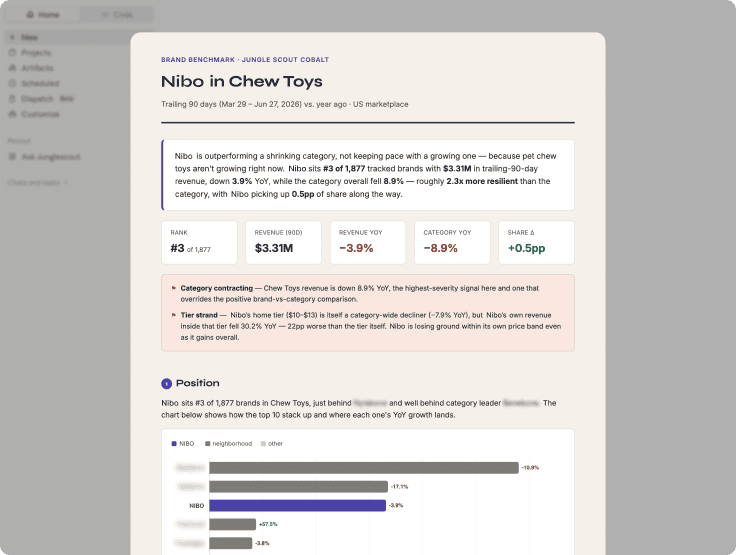
Not necessarily. A brand can outperform a shrinking category while still losing ground in its price tier or to its top competitor. Check both the category-level comparison and the tier- or competitor-level detail before drawing a conclusion.
In Ask Cobalt inside Jungle Scout Cobalt, and through the Jungle Scout MCP in AI tools like Claude, ChatGPT, Gemini Enterprise, and Copilot, where it runs as the brand-benchmark skill.
