Market Trends
Demand shifts build slowly and rarely announce themselves. Surface changes in seasonality and sub-category movement while there’s still time to respond, rather than after a competitor has already capitalized on them.
Example Questions
- “Why is my competitor gaining share?”
- “What trends are emerging in the category right now?”
- “Is this a category-wide trend or specific to a few brands?”
- “Is the recent spike in demand for [category] seasonal, or is it a structural shift — and which brands are capturing the new demand?”
- “Which sub-categories within [category] are growing while the parent category is flat, and what does that imply about where demand is shifting?”
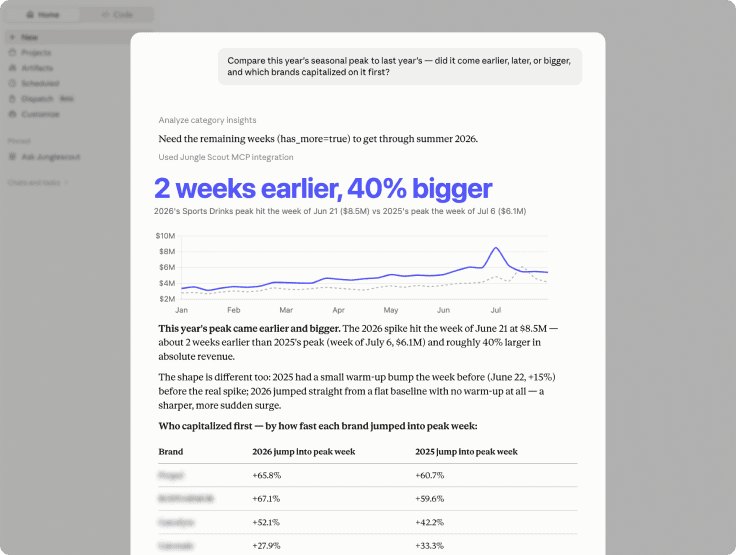
- “Compare this year’s seasonal peak to last year’s — did it come earlier, later, or bigger, and which brands capitalized on it first?”
Frequently Asked Questions
It detects shifts in demand within a category: seasonal changes, sub-categories growing while the parent category is flat, and which brands are capturing new demand. The goal is to spot a shift early enough to act before a competitor does.
Category Sizing gives you the market’s size and growth rate. Market Trends explains what’s moving inside that number, like a seasonal peak arriving earlier or one sub-category surging.
Yes, and that distinction is central to the output. A broad shift calls for a category-level response, while a shift concentrated in a few competitors points to something they’re doing differently.
Yes. It compares current demand to prior seasons, so you can see whether a spike matches last year’s pattern or is a structural change, and which brands benefited first.
It focuses on recent movement over weeks and months, and compares against prior years for seasonality.
In Ask Cobalt inside Jungle Scout Cobalt, and through the Jungle Scout MCP in AI tools like Claude and ChatGPT.
