Sales Estimation
Real sales data for a competitor’s ASIN isn’t available. Model estimated units and revenue from the signals that are. Use the result to size a competitive threat or set a target for a new launch.
Example Questions
- “How many units is [competitor ASIN] selling per month?”
- “What’s [competitor]’s estimated market share based on sales volume?”
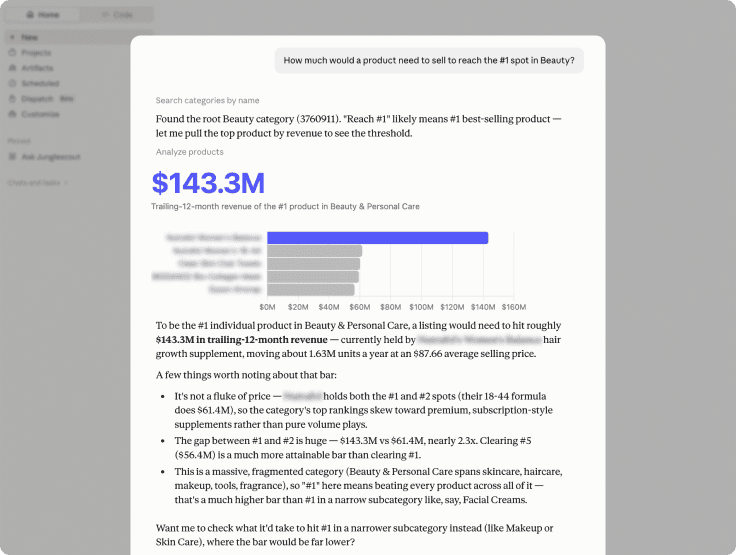
- “How much would a product need to sell to reach the #1 spot in [category]?”
- “Estimate monthly units and revenue for the top 10 ASINs in [category], and tell me what unit volume we’d need to break into that top 10.”
- “Model [competitor]’s estimated revenue over the last 4 quarters and flag whether their growth is accelerating or plateauing.”
- “Estimate category-wide revenue for [category] and compare it year-over-year — is the estimated growth coming from more sellers or higher per-seller volume?”
Frequently Asked Questions
It estimates monthly units and revenue for any Amazon ASIN, including competitors’ products, plus brand-level market share and category revenue. It can also estimate the sales volume a product would need to reach the top 10 or #1 in a category.
They’re modeled from sales rank, category, and benchmark data contributed by sellers, which Jungle Scout uses to calibrate its models. Like any estimate of data Amazon doesn’t publish, they’re best for sizing and comparison rather than exact financial reporting.
Yes. It’s most often used to estimate a competitor’s monthly units or revenue, since that data isn’t publicly available.
Not directly, since it estimates sales for existing ASINs. For an unlaunched product, use Category Sizing, or Product Innovation through the Jungle Scout MCP, to estimate the opportunity.
In Ask Cobalt inside Jungle Scout Cobalt, and through the Jungle Scout MCP in AI tools like Claude and ChatGPT.
