Whether you’re an established brand expanding your portfolio or an emerging brand launching your first product, getting a new product right on Amazon takes more than a strong listing or a successful launch day.
You need to know whether the opportunity is worth pursuing before you invest. You need a plan for pricing, inventory, content, reviews, fulfillment, and advertising before the product goes live. And once it launches, you need to know which signals matter, what they mean, and when it makes sense to adjust or scale.
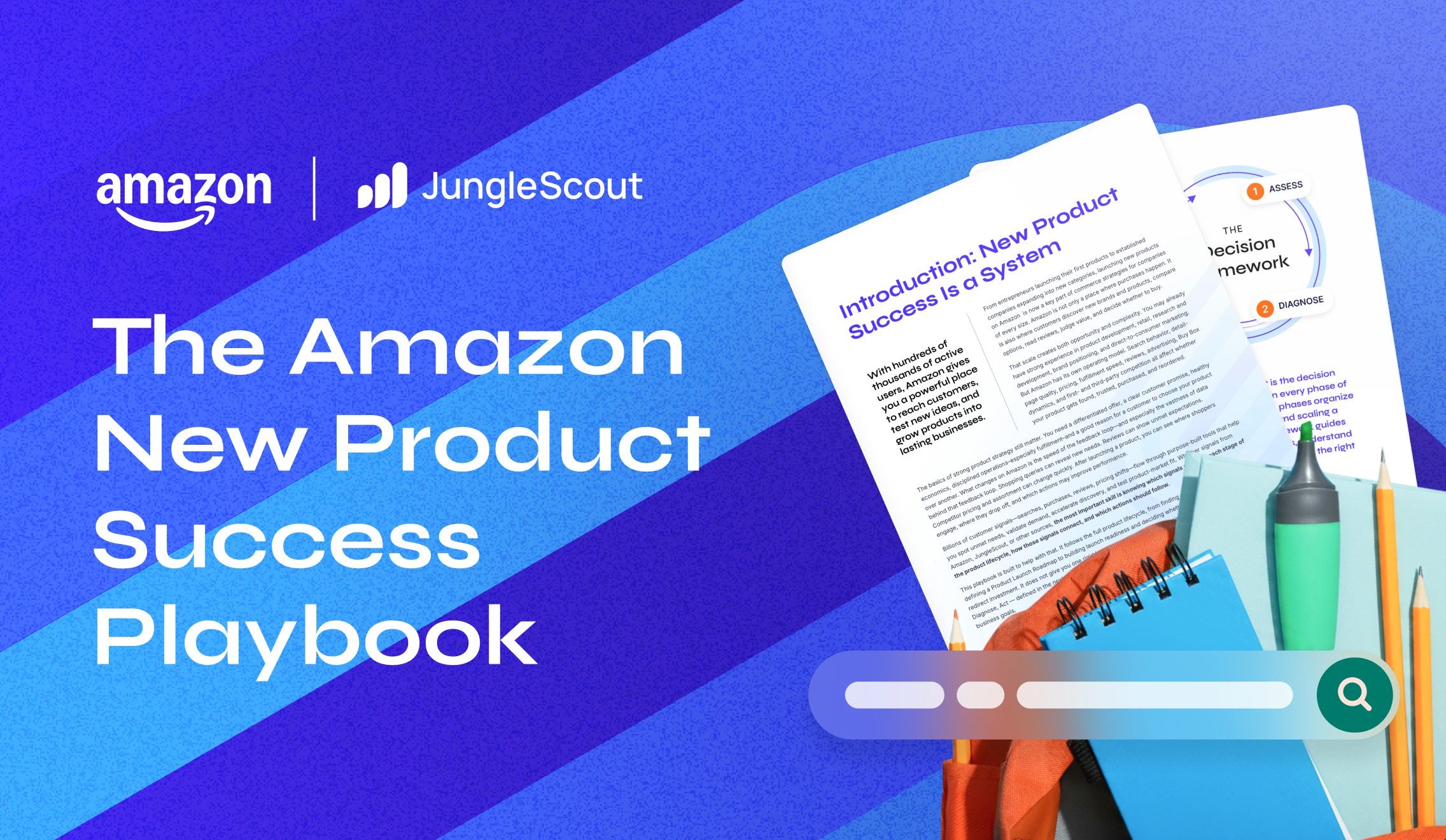
That’s why Jungle Scout and Amazon created The Amazon New Product Success Playbook, a practical guide for planning, launching, diagnosing, and scaling products on Amazon.
The playbook follows the full product lifecycle, from identifying sustainable demand and building a Product Launch Roadmap to preparing for launch, responding to early performance, and deciding whether a product has earned the right to scale.
Product success is a system
A new product launch is not one decision. It is a series of connected decisions.
Before launch, teams need to understand the market opportunity, customer need, competitive landscape, and expected economics.
As launch approaches, the focus shifts to making sure the full offer is ready, including price, fulfillment, inventory, content, reviews, promotions, and advertising.
Once the product is live, the questions change again. Are shoppers finding it? Are they converting? Is the product gaining share? Are reviews exposing a product issue? Is advertising working, or is it simply sending more traffic to an offer that needs improvement?
The playbook brings those decisions together into one repeatable system instead of treating product research, launch planning, advertising, and optimization as separate workstreams.
A simple decision framework: Assess, Diagnose, Act
At every stage, the playbook uses the same three-step decision loop:
Assess: What can you learn from the customer, category, competitive, and operational signals available to you?
Diagnose: What do those signals tell you about the opportunity or your product’s performance?
Act: What should you build, launch, test, or change to improve readiness, visibility, conversion, profit, or growth?
The goal is not to let one tool or metric make the decision for you. It is to bring the right signals together, understand what they mean, and choose the next action with more confidence.
The Assess, Diagnose, Act framework is used throughout four phases of the product lifecycle.
Phase 1: Discover your next winning opportunity
Some of the most expensive launch mistakes happen before a product is ever made.
A fast-growing keyword, viral trend, or emerging competitor may look promising. But by the time inventory reaches Amazon, demand could slow, competition could increase, or the economics may no longer work.
The first phase of the playbook helps teams look beyond a single signal.
That means understanding who is gaining share, how competitors are positioned, where customer needs remain unmet, how pricing and assortment are changing, and whether demand appears durable enough to support the investment.
It also means stress-testing the product itself.
Would customers understand why the product is different? Does it solve a clear problem? Does the proposed price match the value? Are there recurring complaints, returns, or unmet needs that the product can address? And after fees, fulfillment, advertising, promotions, and returns, do the economics still make sense?
From there, the goal is to build a clear Product Launch Roadmap that defines the customer problem, target buyer, intended outcome, meaningful differentiation, and evidence that the opportunity is large, durable, and economically viable.
Phase 2: Build a retail-ready pre-launch plan
A strong product is only part of the equation.
Before launch, the whole purchase proposition needs to be ready: quality, price, delivery speed, availability, reviews, content, and trust.
The playbook walks through how to prepare these pieces as one connected plan.
That includes choosing a price that reflects both customer expectations and market reality, modeling the full cost of selling, selecting the right fulfillment approach, and preparing inventory for more than one demand scenario.
It also covers how to build a sales-ready detail page where the title, bullets, images, A+ Content, reviews, price, and delivery promise work together to help shoppers make a decision.
And because launch activities depend on each other, timing matters.
Driving traffic to an incomplete page wastes spend. A strong detail page with no plan to generate visibility may leave a good product undiscovered. Inventory, Vine reviews, promotions, Sponsored Products, and supporting Brand Store assets should be planned as one sequence before launch.
Phase 3: Execute, learn, and adjust in the first 30 days
Launch day is when live learning begins.
Real customers start interacting with the product. Ads begin generating traffic. Reviews and returns provide feedback. Competitors change price, assortment, or advertising. Inventory and fulfillment begin affecting the customer experience.
The goal during the first 30 days is not to react to every change. It is to protect the core launch system while learning what is actually working.
The playbook lays out an operating sequence for checking availability, price, fulfillment, Featured Offer status, listing quality, customer feedback, promotions, advertising, and performance on a regular cadence.
Advertising also becomes a source of information.
Sponsored Products can help generate visibility while showing which keywords, queries, and product contexts drive engagement and conversion. But advertising performance should be read alongside the rest of the market.
Weak sales may come from limited traffic. They may come from poor conversion. Category demand may be slowing. A competitor may have changed price. Or your product may be losing visibility on the terms that matter most.
That is why the playbook recommends a practical measurement rhythm: daily checks for issues that can interrupt performance immediately, and deeper weekly reviews to diagnose patterns across traffic, conversion, advertising, reviews, returns, and category movement.
Phase 4: Optimize, scale, or iterate from days 30 to 90
Early sales are useful, but they do not tell the whole story.
A product can grow while losing share in a fast-growing category. It can earn clicks but struggle to convert. It can convert well when shoppers find it but remain invisible on important search terms.
From days 30 to 90, the focus shifts from simply launching the product to understanding what is driving the result.
The playbook provides a practical diagnosis sequence for evaluating category demand, product growth, competitor performance, keyword visibility, share of voice, conversion, pricing, reviews, returns, inventory, Featured Offer ownership, and operational interruptions.
It also covers problems that can be easy to miss when teams look only at topline sales.
For example, a brand may have healthy demand but lose sales because another seller is winning the Featured Offer. New or unexpected third-party sellers may change visible pricing, delivery expectations, or control of the offer. The playbook shows how to investigate these signals before deciding what action to take.
From there, teams can make focused changes to the listing and offer, optimize advertising, adjust inventory plans, and decide whether the product is ready for more investment.
The key is that scaling should follow sustainable demand, not a fixed date on the calendar.
Connect Amazon signals with the wider market
Making these decisions requires context.
Amazon tools provide first-party signals about how customers search, engage, and purchase on the digital shelf, along with programs that help sellers prepare for launch and drive growth.
Jungle Scout’s Cobalt adds the wider market view, including category growth, competitive movement, pricing, assortment, visibility, seller activity, and market share.
Jungle Scout MCP makes that intelligence conversational, allowing teams to ask business questions and access Cobalt data directly within their existing AI workflows.
Together, these inputs help teams connect what is happening inside their Amazon account with what is changing across the broader market.
The playbook also shows where tools including Amazon Opportunity Explorer, Brand Analytics, Search Query Performance, Vine, Sponsored Products, FBA, Cobalt, and Jungle Scout MCP can support different decisions across the product lifecycle.
But the principle stays the same: tools inform decisions. They do not replace strategy or judgment.
Build a launch system that gets smarter over time
The final phase does not really end at day 90.
What you learn from one launch should become part of the next.
Search behavior, customer questions, reviews, returns, conversion patterns, competitor moves, pricing changes, and other performance signals can all feed back into the next discovery cycle.
That creates a closed loop. Each launch helps your team get better at assessing opportunities, diagnosing performance, and acting on the signals that matter most.
Because the real measure of a successful launch is not whether it generated sales in week one.
It is whether you learned enough to build a repeatable, sustainable, profitable path to growth.
Get the Amazon New Product Success Playbook
The Amazon New Product Success Playbook gives brands a practical framework they can use from the first product idea through launch, optimization, and scale.
Inside, you’ll find the full Assess, Diagnose, Act framework, step-by-step guidance across all four phases, product and launch readiness checklists, measurement and diagnosis tools, Amazon and Jungle Scout resources, and real-world examples from brands including Garden of Life and 54 Thrones.