Before you start sourcing FBA products, you need proof that the product is worth sourcing. Product research is the stage where you validate demand, competition, and profit potential using real marketplace data. Product sourcing comes after, when you are confident you are backing a winner.
This post is built around the same principles you will see across Jungle Scout Catalyst resources in 2026: follow demand signals, validate with data, and prioritize products with room for new sellers to compete.
What “good product research” means in Jungle Scout Catalyst
In Jungle Scout Catalyst, Amazon product research is not about guessing what might sell. It is about using market and keyword data to answer three questions:
- Is demand high enough to support another seller?
- Is competition low enough to enter realistically?
- Are margins strong enough after FBA fees and shipping?
If you cannot say “yes” to all three, don’t source yet. Keep researching.
Step 1: Start with high demand
High demand is the first filter. You want products customers already buy consistently.
High demand markers to look for
- The niche shows steady monthly sales across multiple top listings, not just one breakout product.
- There are several keywords with meaningful search volume, not a single keyword propping the niche up.
- Demand holds over time. A stable baseline beats a one month spike.
How to check in Jungle Scout Catalyst
- Use Product Database to surface niches with strong sales.
- You can also leverage the Jungle Scout Extension to validate product demand for existing ideas as you browse on Amazon
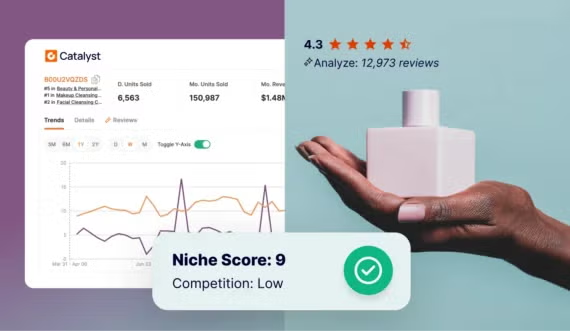
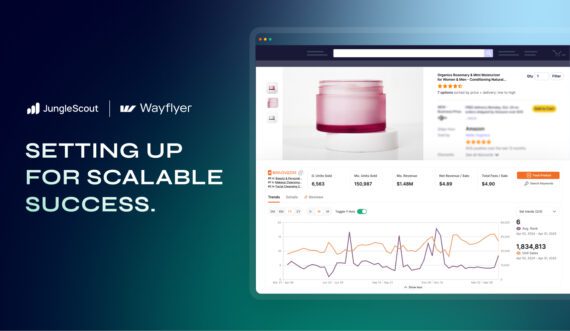
- Confirm the trend line in Category Trends or Opportunity Finder, as well as by tracking your product over time in the Product Tracker.
- Look for patterns across at least a period of 60-90 days to evaluate longer term demand.
If the chart looks like a heartbeat, that is risk. If it looks like a steady climb or stable plateau, that is an opportunity.
Step 2: Pair high demand with low reviews – but keep it brand-focused
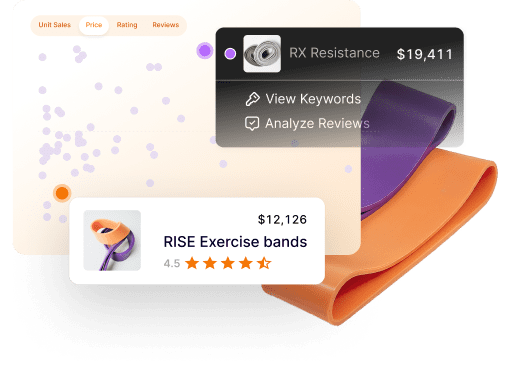
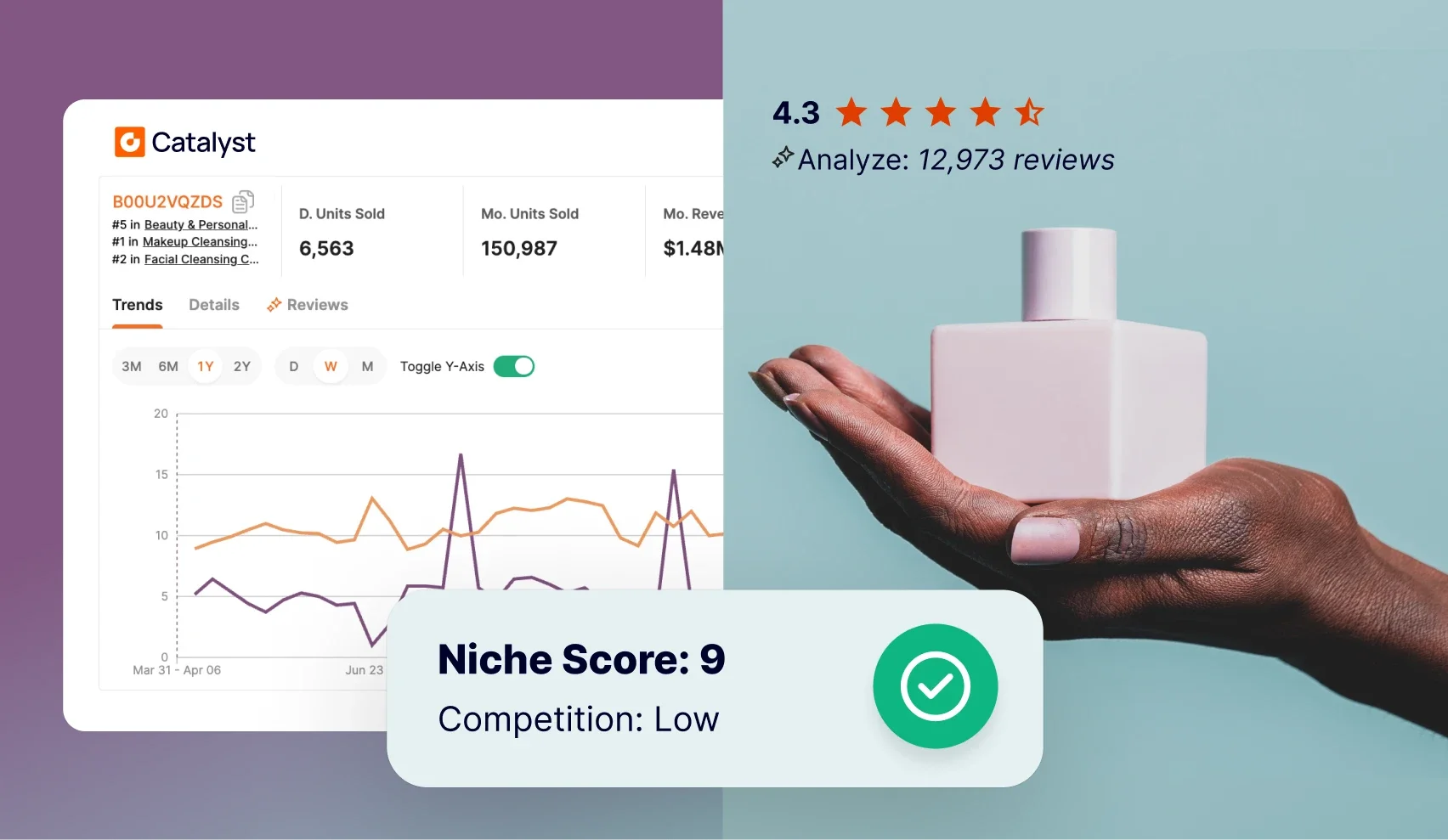
The classic Jungle Scout Catalyst sweet spot is high demand and low reviews. Reviews are one of the simplest competition indicators because they often track how entrenched a niche is.
Still, you need to ensure you can adequately brand and increase shopper demand for your products, especially as your catalog grows. Look for products that are also cohesive and align with the vision you have for your brand, or could be paired with existing products to help upsell shoppers and increase basket size.
Low review competition markers
- The top listings average relatively low review counts.
- Multiple products sell well without needing thousands of reviews.
- Newer listings are ranking and capturing sales, which suggests the niche is still open.
Why this matters
If a product is selling hundreds of units per month with low reviews, buyers are not purely loyal to existing brands. They are still shopping. That gives you a path to enter with a better offer.
Step 3: Look for weak listings you can outperform
Jungle Scout Catalyst encourages sellers to find markets where the product is selling even though listings are not great. That means you can win by improving the customer experience and presenting it better.
Markers of a beatable niche
- Low quality photos or unclear infographics on top listings.
- Confusing titles and bullet points.
- Poor variation setup or missing bundle options.
- Review gaps showing unmet needs.
This is a huge advantage to new brands. If existing sellers are winning with mediocre listings, your upside is real.
Step 4: Validate profitability before you ever contact suppliers
A product can be high demand and low review and still be a bad buy if the margins are thin or if your supply chain is complex.
Profit markers
- Price sits in a healthy mid range where FBA fees do not consume the margin.
- You can estimate a landed cost that supports profit after FBA fees, shipping, and launch marketing.
- The product is not so bulky or heavy that shipping erases your gains.
A simple rule that still holds in 2025: if the numbers look tight before ads, they will look worse after ads.
Step 5: Build differentiation from real review data
Differentiation is not a branding exercise. It starts with understanding what buyers complain about and fixing it.
Differentiation markers
- Reviews repeat the same frustration.
- The fix is practical and affordable.
- The improvement is visible in your main image and easy to explain.
Examples of strong, simple differentiators:
- Better materials or durability
- A more useful size or shape
- A bundle that solves a broader problem
- A small feature that removes a common pain point
Your goal is not to invent something totally new. Your goal is to release the version customers wish already existed.
Step 6: Do a quick “sourcing reality check”
You are still in research mode here. This is just to make sure the product is feasible to source once it passes validation.
Reality check questions
- Are there multiple manufacturers for this type of product?
- Is it simple enough to produce consistently?
- Are there compliance requirements you can meet?
- Is customization realistic at your budget and MOQ?
If the answer is mostly yes, you are ready to source an FBA product.
Where product sourcing fits, and why it comes after research
Once your research shows high demand, low reviews, solid margins, and a clear differentiation angle, sourcing becomes the next logical step.
The order matters:
- Jungle Scout Catalyst helps you choose what to sell, backed by data.
- Product sourcing helps you produce and deliver it competitively.
A simple Jungle Scout Catalyst pre sourcing checklist
Before you source FBA products, confirm:
Demand
- Multiple listings with consistent sales
- Several keywords with strong volume
- Stable trend line over time
Competition
- Low to moderate review counts at the top
- Sales spread across several sellers
- You can spot listing weaknesses
Profit
- Mid range retail price that supports margin
- Landed cost leaves room after fees
- Shipping will not crush profitability
Differentiation
- Clear review based problem to solve
- Fix is affordable and easy to communicate
If you cannot check every box, keep researching. If you can, sourcing is the next move.
Final takeaway
In 2025, the best Amazon sellers are not the fastest sourcers. They are the best validators. Use Jungle Scout Catalyst to find products where high demand meets low reviews, confirm the margins, then build a better version. Only after that should you invest energy into sourcing.